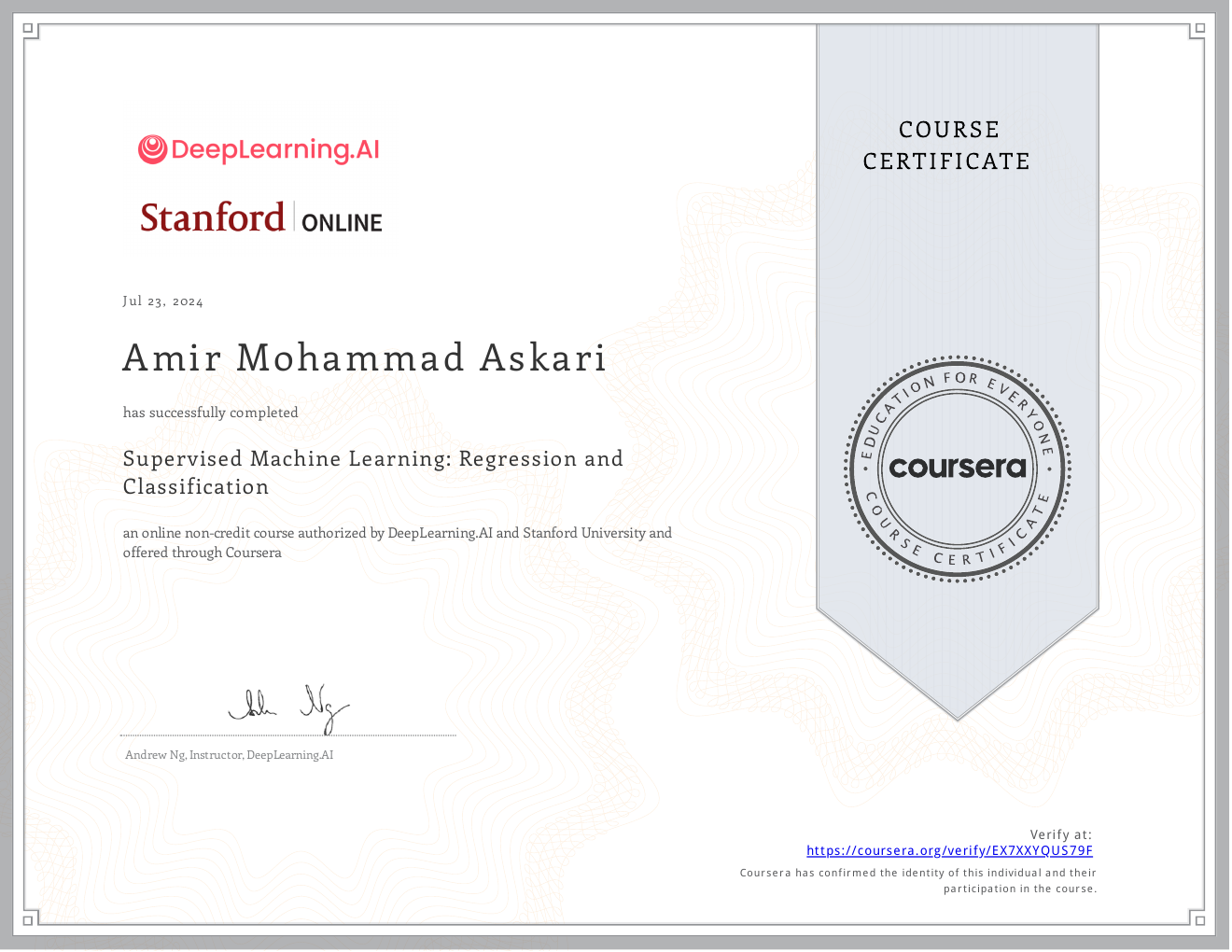
Expanded learning page
What this course added to my engineering stack.
Supervised Machine Learning: Regression and Classification was not just a certificate item. I used it as one layer in a longer path: understand the concept, implement it in code, test it on assignments or notebooks, then connect the idea to future portfolio systems.
01 · Core roleWhy I studied it
This course gave me the first rigorous ML foundation. It made regression and classification feel mathematical and practical at the same time: choose a hypothesis, define a cost, optimize parameters, evaluate behavior. The reason it matters on this page is that it shows the exact stage where my learning moved forward, instead of presenting education as a flat list of names.
02 · ConceptsWhat I focused on
The most important layer was not memorizing definitions; it was learning how the course concepts behave when they are turned into working code, trained models, evaluation outputs, and notebooks.
hypothesis functionscost surfacesgradient descentlinear vs logistic objectivesregularized trainingerror analysis
03 · Practice methodHow I used it
I treated the course as a practical loop: watch the theory, re-implement the assignment logic, inspect outputs, record results, and then keep the code in a public repository as evidence of the learning process.
04 · Portfolio connectionHow it connects
This became the base for later work with SVC, decision trees, random forests, gradient boosting, XGBoost, CatBoost, LightGBM, and neural networks. This page is represented as a learning foundation. Even without a separate milestone gallery here, it explains the role of the course in the larger path from programming foundations to AI engineering.
Theorymathematical or conceptual model
Implementationnotebooks, functions, model code
Evidencecertificate, repo, outputs, milestones
Engineering useapplied later in apps and research
Learning notes
I practiced supervised learning workflows: numerical features, regression targets, binary classification, logistic decision boundaries, gradient descent, feature scaling, and error evaluation. It also helped me understand why model performance is tied to data quality and evaluation design. I also used the course to improve how I explain technical decisions: why a model is chosen, what assumptions it makes, where it fails, and what the next improvement should be. That explanation layer is important because my goal is end-to-end AI engineering, not only passing assignments.
Evidence and navigation
- Official course page is linked for source context.
- GitHub repository is linked where I have public code.
- Certificate or badge appears in the showcase when available.
- Milestone cards open separate pages when the course has larger labs or projects.