Back to Education
Book · Sebastian Raschka · Manning

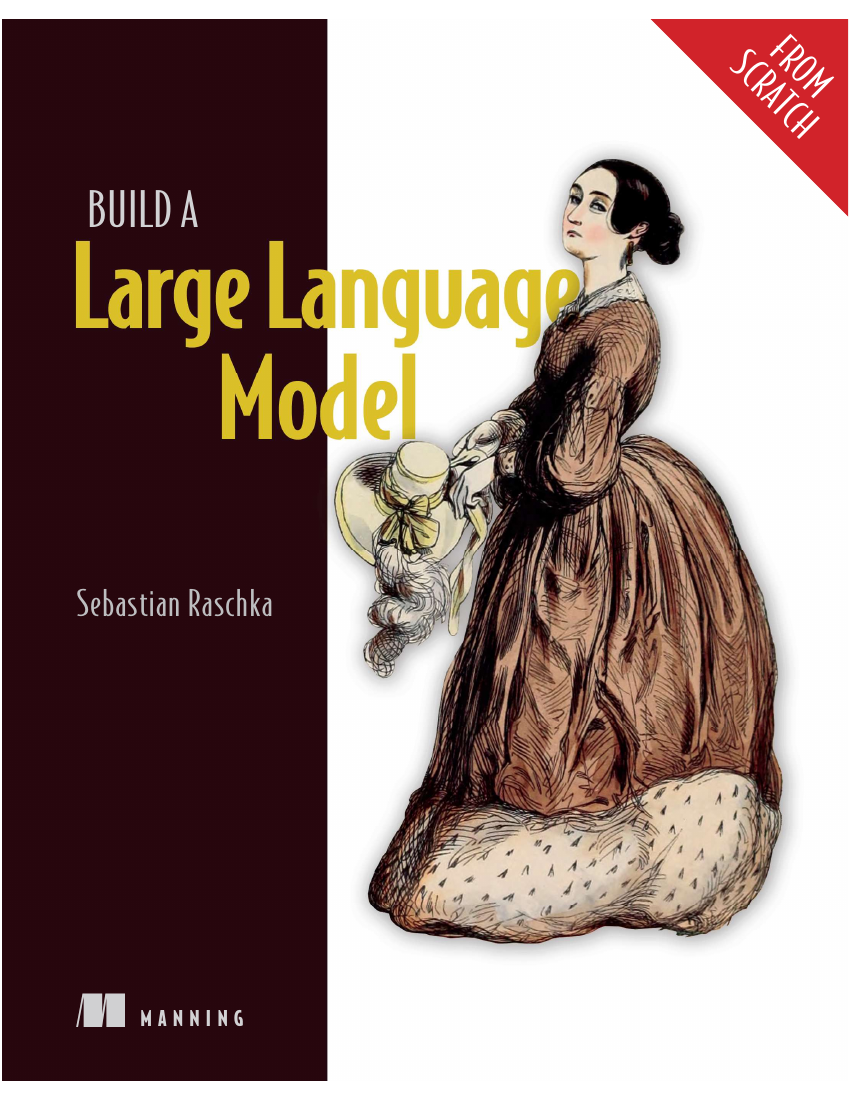
Build a Large Language Model From Scratch

This book belongs to my current/future LLM path. I do not want to only call LLM APIs; I want to understand the internal machinery behind tokenization, attention, GPT blocks, pretraining, evaluation, and fine-tuning.

LLM internalsTokenizationAttentionGPTPretrainingFine-tuning
Build a Large Language Model From Scratch

What I learned

The focus is on building a language model step by step: preparing text, sampling batches, tokenizing, creating embeddings, implementing attention, stacking Transformer blocks, loading pretrained weights, and fine-tuning for classification or instruction-following behavior.

Why it mattered in my path

It supports my longer target: mastering LLM fundamentals before moving deeper into RAG, agents, and production GenAI applications.

How this book fits into my AI engineering path.

For me, a technical book is useful only when it becomes a working mental model. This page explains what I used Build a Large Language Model From Scratch for, how it connects to implementation, and why it belongs in the Education archive.

Reading purpose

This book belongs to my current/future LLM path. I do not want to only call LLM APIs; I want to understand the internal machinery behind tokenization, attention, GPT blocks, pretraining, evaluation, and fine-tuning. I did not treat it as a passive reading item. I used it to slow down, inspect architectures, connect code with theory, and understand the engineering decisions that are often hidden behind course assignments.

Technical layer I extracted

The focus is on building a language model step by step: preparing text, sampling batches, tokenizing, creating embeddings, implementing attention, stacking Transformer blocks, loading pretrained weights, and fine-tuning for classification or instruction-following behavior. The important point is that this book gave me vocabulary and implementation structure: how to describe a pipeline, how to compare approaches, and how to think about model behavior beyond one training log.

Impact on my next work

It supports my longer target: mastering LLM fundamentals before moving deeper into RAG, agents, and production GenAI applications. It also made the bridge to larger portfolio projects clearer: each topic can become a deployable component, a research experiment, or a part of an end-to-end AI application.
01

Conceptual depth

The page describes what I wanted to understand beneath the API calls: objectives, architectures, data representation, training dynamics, and failure modes.

02

Implementation depth

Where notebooks or code exist, the book is connected to concrete experiments instead of staying as a decorative bookshelf item.

03

Career direction

The book supports the long-term direction of becoming stronger in AI engineering, MLOps, NLP/LLMs, and advanced systems.